The conversation around marketing consultancy is heavily skewed towards larger businesses and how to integrate senior marketing professionals into an established structure.
Senior leadership. Fractional CMO. Board-level strategy.
Which can all sound a bit over the top if you're running a ten-person business and all the marketing decisions are coming your way because you don't have mid-to-senior marketing owned by somebody in-house.
In reality, most conversations about bringing in support are about growth and pipeline regardless of company size. Maybe you're hearing, "Why haven't we heard of you?" Maybe you're getting leads but they aren't matching your ICP. Maybe your product has evolved but your positioning hasn't kept pace.
All of these things can happen to businesses in the start-up to scale-up phase, just as much as they can affect multinationals.
For businesses operating in complex or regulated markets, finding the right support can be even more important. A marketing consultant for fintech and regtech needs to understand more than marketing fundamentals. They need to understand the buyers, sales cycles, competitive landscape and regulatory environment their clients operate in.
So when the conversation turns to "We need help. And we don't want to add headcount", what next?
When to bring someone in
Before you set out to search for a marketing consultant, you need to establish the scope. What are you actually asking them to do?
This sounds obvious, but it's one of the easiest things to get wrong.
If the problem is simply that you need someone to produce content, run your social channels or improve your SEO, you probably need a specialist.
But if the problem is broader — we have a good product, we're growing, but our marketing isn't really working as a system — you need someone who can diagnose the problem before jumping into execution.
Some useful questions to ask are:
- Do we know who we're trying to reach and why they should choose us?
- Is our positioning still right for the business we're becoming?
- Are we generating enough of the right opportunities?
- Is marketing actually connected to sales and revenue?
- Do we have the infrastructure and processes to measure what's working?
- Do we have enough founder visibility and third-party credibility in the market?
- Do we know what we should stop doing?
If you can't answer some of these questions, the first job of your consultant may be to work out what the marketing problem actually is.
How to bring someone in
Once you know what you need, think about the level of support required.
A consultant doesn't necessarily need to become a permanent part of your organisation. In fact, that's often the point.
You might bring someone in for a defined project — to reposition the business, build an ABM programme, develop a go-to-market strategy or fix your demand generation.
Alternatively, fractional marketing can provide ongoing senior support for a few days a month. This can be particularly useful when you're not yet ready to hire a full-time Head of Marketing or CMO, but the business has outgrown founder-led marketing.
For a fintech or regtech business, this can be particularly valuable. You can bring in senior marketing expertise without immediately committing to a full-time marketing hire, while still having someone who understands your market and can connect positioning, visibility, demand generation and growth.
The important thing is to be clear about the outcome you're buying.
"We need someone to do marketing" isn't a particularly useful brief.
"We need to build a repeatable demand generation programme for our target enterprise accounts over the next six months" is.
The latter gives both sides something to work towards and makes it much easier to decide whether the relationship is working.
Who to bring in
There are many types of marketing consultants — from freelancers to agencies.
Depending on the scope, you might be happy working with one freelancer who has skills that cover the breadth of your requirements, whether that's SEO, copywriting, events planning or account-based marketing.
For a more complex requirement, you might need a specialist agency or a senior consultant who can bring in other expertise as required.
And then you need to consider their industry experience.
They might be a phenomenal copywriter, but have they ever worked in your industry? If not, how long is it going to take them to get up to speed?
This matters particularly in complex or regulated sectors. A marketer can be excellent at demand generation, but if they don't understand your buyers, sales cycle, competitive landscape or regulatory environment, you'll spend time and money getting them there.
Equally, don't make industry experience the only criterion.
You want someone who can think, not just someone who has worked in your sector before.
Ask them how they would approach your problem. What would they want to understand first? What would they prioritise? What would they challenge?
A good consultant shouldn't simply arrive with a list of tactics they use for every client.
The right consultant should make your job easier
Ultimately, hiring a marketing consultant isn't about adding another person to manage.
It's about bringing in expertise that you don't currently have — and using it to make better decisions, faster.
For a smaller or scaling business, that might mean bringing in a senior marketer through fractional marketing, giving you the expertise of a senior marketing leader without the cost or commitment of a full-time hire.
It might mean a specialist who comes in, fixes a specific problem and leaves.
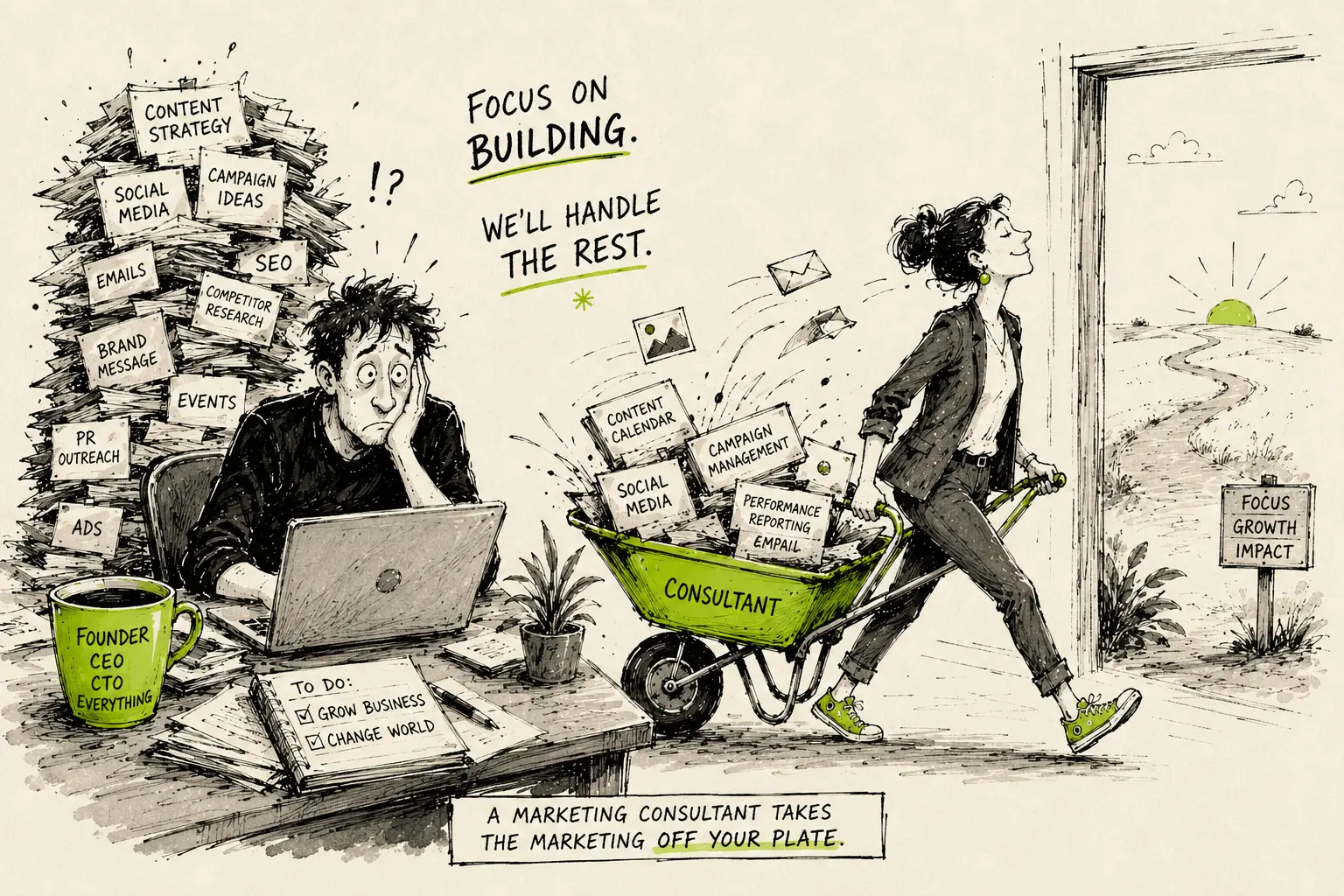
Or, particularly for fintech and regtech founders, it might mean bringing in someone who can connect marketing with founder visibility, positioning and commercial growth.
The right answer depends on the problem you're trying to solve.
But if you can clearly articulate where the business is trying to get to, what's currently getting in the way, and what you need from your marketing function, you're already much closer to finding the right person.
And if you're looking for a marketing consultant for fintech and regtech, the same principle applies: start with the business problem, then find the level and type of expertise that can actually solve it.
That might mean helping set priorities, managing agencies and freelancers, working with sales, building campaigns, reviewing performance and keeping the whole thing commercially focused.
The exact model should depend on what the business actually needs.
When is fractional marketing worth it?
I wouldn't use revenue as an absolute rule.
A £1m business with a clear enterprise opportunity may need senior marketing much more urgently than a £3m business that's still primarily founder-led.
But there is a point where marketing stops being something you can manage by instinct.
If you're growing quickly, entering new markets, moving upmarket or trying to build predictable pipeline, not having a clear marketing strategy starts to become expensive.
That's usually the point at which bringing in senior marketing expertise — whether fractionally or permanently — starts to make sense.
What should you look for in a fractional marketing consultant?
I'd look for someone who understands the business, not just marketing.
- Can they understand your commercial objectives?
- Can they tell you what not to do?
- Do they understand sales, customers, positioning and pipeline?
- Can they work independently without needing a huge team around them?
- And, importantly, will they tell you honestly if they don't think marketing is actually your problem?
I think that last one matters.
I've spent 17 years working across B2B SaaS, fintech, regtech and financial services, including senior in-house marketing roles and working directly with founders and leadership teams. My approach is deliberately commercial: work out what needs fixing first, then decide what marketing activity is actually worth doing.
Start with the conversation, not the contract
A good fractional marketing consultant shouldn't need to sell you a six-month retainer before understanding your business.
The first conversation should be diagnostic.
- What's happening in the business?
- Where do you want to get to?
- What's currently generating growth?
- What's not?
- What have you already tried?
- And what do you actually need from marketing?
If someone can answer those questions before recommending a solution, you're probably having the right conversation. Ultimately, their curiosity during the discovery calls should give you valuable insight into how they think, how they work and how much understanding of your market they already possess.
Fractional marketing isn't about adding another person to your business. It's about getting senior marketing thinking and execution when you need it — without building a full-time marketing department before you're ready.