Inbound marketing is one of those phrases that gets used so often that it can start to mean almost anything. Blogs, SEO, LinkedIn, email newsletters, lead magnets, podcasts, webinars and now AI search can all be part of an inbound marketing strategy, but inbound marketing itself is not really about producing lots of content.
It is about creating a system that helps the right people find you, understand what you do, trust that you know what you're talking about and eventually decide to buy from you — without you having to go and find them first.
That distinction matters because if your marketing strategy depends entirely on cold outreach, networking and chasing people for meetings, you are constantly starting from zero. Inbound gives you another route in.
What is inbound marketing?
Inbound marketing is a strategy built around attracting potential customers by creating useful, relevant content and experiences that answer their questions and help them solve problems. Rather than interrupting people with advertising or unsolicited messages, you create things they actively want to consume.
That might mean writing a blog post that answers a question your customers regularly ask, publishing a guide that helps them understand a complicated issue, sharing a genuinely useful point of view on LinkedIn, creating a case study or building search-optimised content that appears when someone is actively looking for a solution.
The principle is fairly simple: help first, sell second.
HubSpot describes inbound marketing around three broad stages — attract, engage and delight — while Forbes similarly defines it around creating useful content and experiences that attract people rather than relying primarily on interruption-based marketing.
You are not trying to convince absolutely everyone that they need your product or service. You are trying to become visible to the people who already have a problem you can solve.
Inbound vs outbound marketing
The easiest way to understand inbound marketing is to compare it with outbound marketing.
With outbound, you go looking for potential customers. With inbound, potential customers find you.
Cold email is outbound. A Google search that brings someone to your website is inbound. A LinkedIn message to a prospect is outbound. A prospect reading several of your articles before contacting you is inbound.
Neither approach is inherently better, and I certainly wouldn't argue that businesses should abandon outbound marketing. The best marketing strategies will often use both.
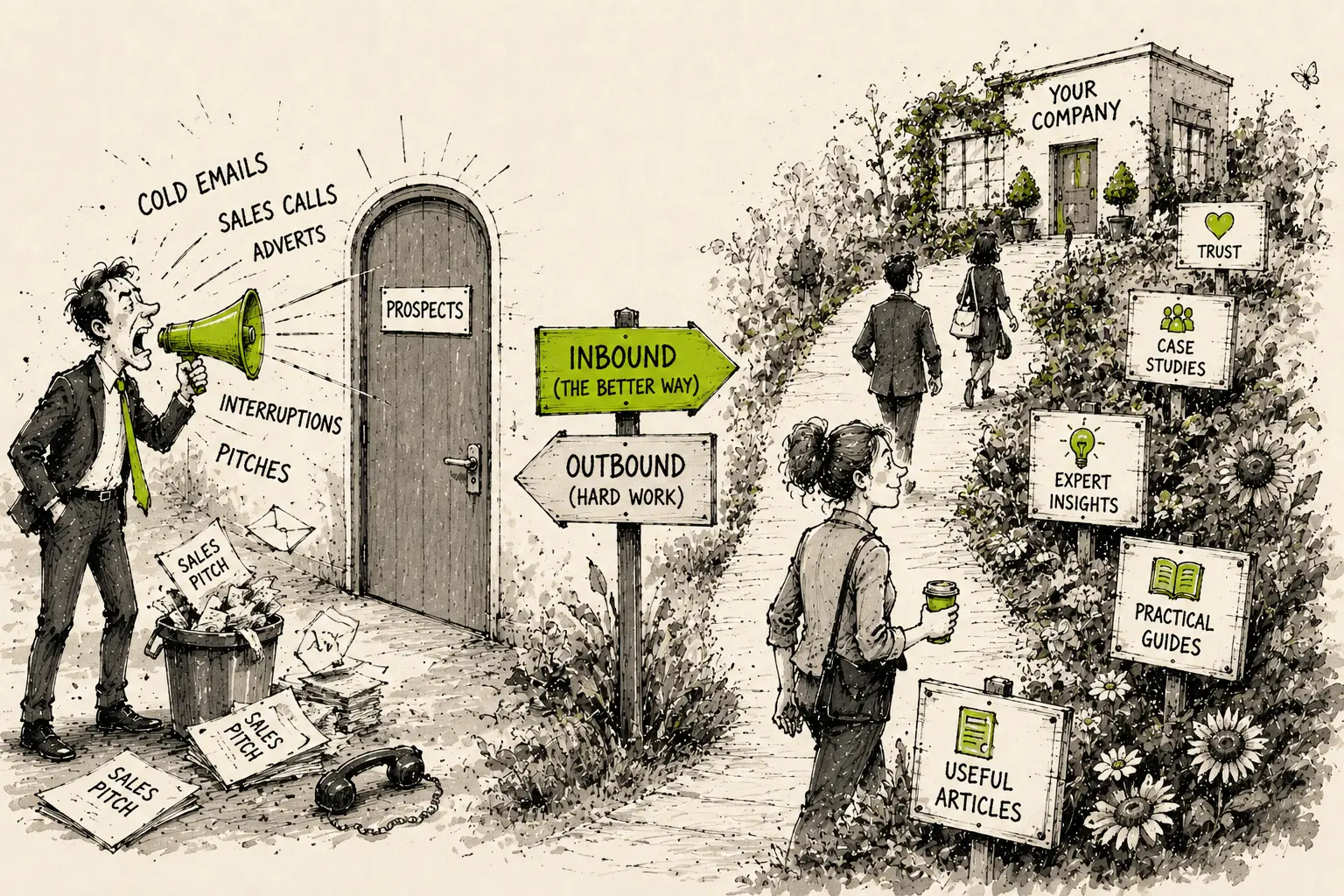
Outbound gives you control over who you approach and how quickly you can create conversations. Inbound takes longer to build, but it creates an asset that can keep working when you are not actively prospecting.
That is the bit I find particularly interesting.
Why inbound marketing matters for B2B businesses
B2B buyers rarely wake up one morning and decide to spend a significant amount of money with a company they know nothing about. Particularly in industries such as fintech, regtech, cybersecurity and financial services, the buying process can involve considerable research before anyone is prepared to get in touch.
People look at your website, search your name, read your LinkedIn posts and look at what other people have said about you. They search for your expertise and look at your customers, partnerships, press coverage and people.
Increasingly, they also ask AI tools for information and recommendations.
So your marketing needs to do more than generate a click. It needs to build credibility before the sales conversation happens.
That is where a good inbound strategy becomes much more powerful than simply publishing "content".
Your website should be at the centre of the system
One of the biggest mistakes I see businesses make is treating their website as a brochure: a few pages explaining what the company does, a list of services, some customer logos and a contact form.
But your website can become the place where potential customers educate themselves before they ever speak to you.
If someone searches for "what is regulatory reporting software?" and finds an article you've written, you have entered their buying journey. If someone searches for "how do I choose a KYC provider?" and finds a genuinely useful guide, you have entered it again. If someone searches for your company after seeing your founder quoted in The Financial Times, your website should reinforce the credibility that initially brought them there.
The individual pieces of content are doing different jobs, but together they create something much more valuable: a body of evidence that demonstrates that you know what you're talking about.
SEO is part of inbound marketing — but it isn't the whole thing
SEO is often treated as synonymous with inbound marketing, but it isn't.
SEO helps your content get discovered through search engines, and HubSpot recommends optimising inbound content around the topics, questions and problems your target customers are actually searching for.
But you can have excellent SEO and still have poor inbound marketing, because ranking is only half the job.
Someone might find your article and think, "That's useful." But if they then look at the rest of your website and cannot work out what you actually do, who you work with or why they should trust you, you've lost them.
Good inbound marketing connects the dots: search leads someone to useful content, that content demonstrates expertise, your wider website builds credibility, and eventually that credibility helps turn an anonymous visitor into an enquiry.
Good content doesn't have to mean more content
This is another misconception I would like to disabuse.
Inbound marketing does not mean publishing five LinkedIn posts a day, sending a newsletter every Tuesday and producing a 40-page ebook every quarter. More content is not necessarily better content, and producing things simply because you feel you ought to be "doing content marketing" is unlikely to produce much of a result.
One excellent article answering a question your ideal customer actually has is worth more than ten generic posts about "the future of fintech". One genuinely insightful founder perspective can be more valuable than a month of corporate LinkedIn filler, and one strong case study can do more for your sales process than another product announcement.
Forbes makes a similar point: consistency matters, but the content still needs to be useful to the audience and help them move towards solving a problem or achieving a goal.
The objective isn't to become a content factory. It is to build a library of useful evidence that answers the questions your potential customers are asking.
Inbound marketing compounds
This is probably my favourite part of inbound marketing.
Most outbound activity has a fairly obvious shelf life. You send an email, someone replies or doesn't, you have a conversation, you follow up and eventually that particular activity is finished.
Content is different.
If you write an excellent article today, someone can find it next month, six months from now or in two years' time. It can rank in search, be shared on LinkedIn, be discovered by a journalist researching a story or be read by a prospective customer before they decide to book a call.
Another piece of content can link to it, and another can build on the same subject.
Over time, you aren't just producing individual marketing assets. You are building an asset base.
That is why inbound marketing can become increasingly valuable as a business matures. HubSpot describes this as a flywheel, where attracting people, engaging them and creating good customer experiences can generate further momentum rather than treating every marketing interaction as a completely separate campaign.
Inbound marketing is changing
There is another reason I think inbound is particularly interesting now: people don't just search Google anymore.
They search LinkedIn, watch YouTube, listen to podcasts, browse communities and ask ChatGPT and other AI tools questions. The journey from having a problem to finding a potential supplier is becoming increasingly fragmented.
That means having a strong digital footprint matters more, not less.
If your company has useful information, expertise, opinions and third-party credibility distributed across the web, there are more opportunities for prospective customers — and increasingly AI systems — to encounter it.
If your website says very little beyond "We are a leading provider of innovative solutions", there isn't much to discover.
So what does a good inbound marketing strategy actually look like?
For a B2B business, I would start with five things.
1. Know what your customers are actually looking for
The starting point should not be what you want to talk about. It should be what your customers are trying to understand.
What problems are they trying to solve? What questions do they ask before buying? What do they need to understand before they will trust a supplier? What are they searching for when they realise they have a problem?
Those are your content opportunities.
2. Build content around those questions
Once you understand what your audience is looking for, create genuinely useful articles, guides, case studies and insights around those subjects.
Don't write for an algorithm. Write for the person who has the problem, and then optimise the content so that person can actually find it.
3. Make your website reinforce your expertise
Your website should make it obvious who you help, what problem you solve, what you know, why you're credible, what you've achieved and what someone should do next.
Content gets people through the door. Your website needs to give them a reason to stay.
4. Add third-party credibility
This is particularly important for B2B companies.
Your own website saying you're excellent is useful, but someone else saying you're excellent is much more powerful. Press coverage, customer stories, awards, speaking appearances, partnerships and expert commentary all contribute to the same thing: proof.
That is why I don't think inbound marketing and PR should be treated as completely separate disciplines. Good PR creates third-party evidence, good content gives people somewhere to go when they discover you, and your website brings it all together.
5. Keep doing it
This is the least exciting part, but it is also the part that makes the difference.
Inbound marketing isn't a campaign you switch on for six weeks. It is a system you build. The results can be slow at first because you are creating an asset base from scratch.
But eventually you can reach a point where someone discovers one article, reads another, sees your founder quoted somewhere, checks your website and books a call — without you ever having sent them a cold email.
That is when inbound starts to feel very different.
Inbound marketing isn't about stopping outbound
I don't think the answer is to throw your outbound strategy in the bin and declare that you'll only do inbound from now on. Especially if you're building a business from scratch, you probably need both.
Outbound creates conversations now. Inbound builds visibility that can create conversations later.
The real goal is to stop making every new business opportunity depend on you personally finding the next person to email.
Because the best inbound marketing creates something incredibly valuable: people who are already interested in what you do coming to you.
And once you've experienced that, going back to relying entirely on cold outreach feels rather painful.
If your website is getting traffic but not enquiries, or you're producing content without really knowing whether it is building visibility, get in touch. I help B2B fintech and regtech businesses build the visibility, credibility and content systems that make inbound marketing work harder.
*Sources: Forbes Advisor, "What Is Inbound Marketing?" and HubSpot, "What Is Inbound Marketing?"*